Click here if you are having trouble viewing this message.
|
|
|
|
|
|
|
|
|
|
|
|
Hello readers,
One pattern became impossible to ignore in May.
Across every sector we work in, the conversation shifted. Leaders stopped asking whether AI is ready for their organisation. They started asking whether their organisation is ready for AI. That is a fundamentally different question, and it points to a fundamentally different set of problems.
The pattern is consistent whether you are running water infrastructure, pharmaceutical supply chains, luxury hospitality groups, or enterprise IT programmes. Fragmented data. Disconnected systems. Operational visibility that exists in parts but never as a whole. The technology investment is real. The returns are not arriving at the scale expected. And the reason, almost without exception, is not the technology.
It is the foundation underneath it.
This edition maps that gap sector by sector. Not with broad observations, but with the specific, structural thinking that closes it. Why AI deployments stall despite heavy investment. How field operations are becoming intelligence-led by fixing process before technology. Why data architecture has stopped being an IT conversation and started being a boardroom one. And how the enterprises pulling ahead are doing it, not by adopting more, but by building clearer.
If your organisation is somewhere between the ambition and the result, this edition is for you.
|
|
|
|
|
|
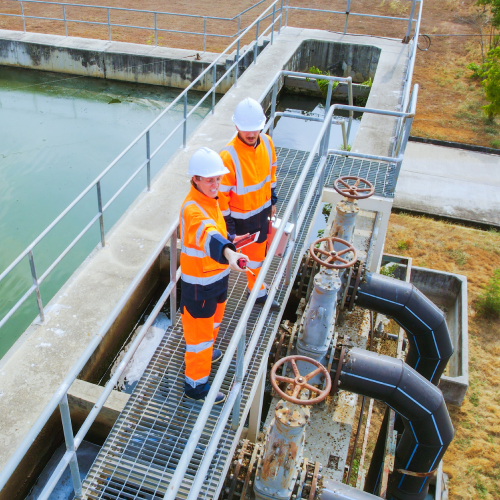
The water sector is sitting on more operational data than it has ever had. The problem is not collection. It is coherence. Fragmented engineering records, unmetered blind spots, and reactive maintenance cycles are costing utilities in ways that rarely appear on a single dashboard. This month's water content goes directly at the structural fixes. |
|
|
|
Debt recovery in the water sector is resource-intensive and poorly targeted. Predictive customer insight is changing which accounts get prioritised and how early intervention gets triggered...
|
|
|
|
|
|
Non-household accounts carry outsized revenue risk but receive disproportionately little analytical attention. This article makes the case for reclassifying them as strategic data assets...
|
|
|
|
|
|
Field engineers, asset managers, and central operations teams are routinely working from different versions of the same information. The consequences of that gap are both operational and regulatory...
|
|
|
|
|
|
Calendar-based maintenance cycles were designed for predictability, not performance. Risk-based AI planning is replacing fixed schedules with decisions driven by actual asset condition data...
|
|
|
|
|
|
|
|
In pharmaceutical operations, the margin for data error is zero. Yet most pharma organisations are still running supply chains on fragmented systems, treating compliance as overhead, and deploying AI without the integration layer it needs to function. This month's thinking challenges all three assumptions. |
|
|
|
In pharmaceutical operations, partial visibility is functionally the same as no visibility. This article examines why fragmented data architecture remains the primary reason supply chain AI fails to deliver...
|
|
|
|
|
|
Track-and-trace requirements in pharma are typically treated as overhead. Organisations reframing compliance as an intelligence layer are building something far more valuable than audit trails...
|
|
|
|
|
|
Traceability is the floor, not the ceiling. This piece explores how agentic AI is beginning to autonomously manage exception handling, supplier deviation, and real-time decision escalation in pharma...
|
|
|
|
|
|
|
|
Luxury is defined by consistency. Fragmented systems make consistency structurally impossible. The hospitality sector's technology problem is not a shortage of platforms - it is too many of them, none speaking to each other, all creating gaps in the guest experience that no front-of-house training can close. |
|
|
|
Property management systems were never designed to anchor a guest intelligence strategy. The organisations moving fastest in hospitality are building around an entirely different core...
|
|
|
|
|
|
Fragmented technology stacks make operational consistency structurally impossible. This piece makes the case for consolidation as a competitive priority, not just an operational one...
|
|
|
|
|
|
Scale in hospitality creates an IT complexity that most groups manage reactively. This article frames the architectural challenge clearly and identifies where operational costs actually accumulate...
|
|
|
|
|
|
The booking journey is being redesigned by agents that learn, adapt, and act on guest intent in real time. This piece maps what that shift looks like and what it demands of hotel technology teams...
|
|
|
|
|
|
Most loyalty programmes are measured on redemption rates and member counts. This article introduces sharper financial metrics and a practical path toward programmes that generate genuine returns...
|
|
|
|
|
|
|
|
|
|
Field service has a documentation problem, an AI adoption problem, and increasingly, a compliance problem. The organisations getting ahead are not throwing more technology at it. They are fixing the process layer first, and building intelligence on top of something stable. |
|
|
|
Every field service organisation has a documentation lag. Few have quantified what it costs. This article puts a number on the problem and shows how intelligent capture is beginning to close it...
|
|
|
|
|
|
The failure pattern in field service AI is remarkably consistent and almost never a model problem. This piece identifies the process, data, and change management gaps that explain most failed deployments...
|
|
|
|
|
|
Regulatory frameworks in telecoms are typically treated as cost. Organisations approaching TM Forum compliance as a data and architecture discipline are finding it delivers something quite different...
|
|
|
|
|
|
|
|
Some problems don't belong to one industry. They belong to every organisation that has been running on inherited architecture, siloed data, and delivery models designed for a slower pace of change. This section is for the leaders who know the foundation needs work before the roadmap makes sense. |
|
|
|
Operational teams don't trust what they can't interrogate. This piece unpacks why explainability is not a feature request but a fundamental requirement for AI adoption in high-stakes environments...
|
|
|
|
|
|
Invisible inefficiencies in supply chain workflows drain margin at every handoff. AI-powered stage analysis is surfacing the losses that spreadsheet reporting simply cannot see...
|
|
|
|
|
|
Before the model. Before the deployment. Before the budget conversation. There is one question that determines everything: is your data infrastructure actually production-ready?
|
|
|
|
|
|
Every enterprise is piloting RAG. Far fewer are running it reliably in production. This is the honest account of what enterprise-scale deployment actually looks like beyond the proof of concept...
|
|
|
|
|
|
|
|
How the work gets done is as strategic as what the work is. With skills shortages structural rather than cyclical and delivery expectations accelerating, the organisations winning are not just choosing better technology. They are choosing better operating models. |
|
|
|
The delivery model conversation is one most organisations delay until a project is already struggling. This piece brings it forward with a clear framework for making the choice well in advance...
|
|
|
|
|
|
Three delivery models, very different risk profiles, cost structures, and scaling ceilings. This article gives IT leaders the criteria to evaluate which configuration their organisation actually needs...
|
|
|
|
|
|
The skills gap in UK contracting is structural, not cyclical. This piece documents what the organisations navigating it successfully are doing differently, and what that means for technology strategy...
|
|
|
|
|
|
|
|
Our platforms don't sit in a product catalogue. They sit inside the problems our clients are solving right now. This section puts each one in its operational context, because that is the only context that matters. |
|
|
|
Loyalty programmes assigned to marketing budgets are treated as campaigns. Organisations that move loyalty into the infrastructure layer build something structurally different, and far more durable...
|
|
|
|
|
|
At volume, conversational AI is not a feature — it is an infrastructure decision. This piece examines what it takes to architect a platform that performs reliably at tens of millions of interactions...
|
|
|
|
|
|
Organisations running multiple ERPs face a structural barrier most AI vendors ignore entirely. This piece names the problem clearly and outlines how intelligent harmonisation changes the equation...
|
|
|
|
|
|
|
|
Clarity Before Complexity
The organisations winning in 2026 are not deploying more. They are building clearer.
Clearer data. Clearer architecture. Clearer decisions about what the foundation needs to hold before anything else is built on top of it.
That is the work. That is what this edition was about.
See you next month.
|
|
|
|
|
|
|
|
|
|
|
|
|
|
|
|
.jpg)







__secure_collaboration_without_compromise.jpg)






















.jpg)